


Buying guide · Marking & measuring
Square or sashigane?差金 · the Japanese carpenter's square
A Western try square checks and marks 90° from a thick, rigid stock. A sashigane is a thin, flat steel L that lies on the work, flexes to follow it, and carries hidden scales on the back that do maths for you.
- All Shinwa, made in Japan
- Sashigane from $46
- 14-day no-questions returns
Same right angle, different jobs
Both give you a true 90°. The difference is how they sit on the timber and what else they can tell you.
| Try squareWestern square · sukoya スコヤ | SashiganeJapanese carpenter's square · 差金 | |
|---|---|---|
| Shape | A thick stock with a thin blade fixed at 90°. | A flat L. Both arms are the same thickness and sit flush. |
| How it registers | The stock hooks over the edge of the board, so the blade drops square across the face. | Hook the edge of either arm against the board, or lay it flat and sight to a line. It works from inside or outside the corner. |
| Rigidity | Rigid. Nothing moves. | Thin steel flexes slightly, so it lies flat on cupped boards and can bend around a post or round stock. |
| Typical size | 45 mm to 150 mm blades. | 15 × 30 cm up to 25 × 50 cm arms. |
| Scales | Millimetres on the blade. Our 15 cm Shinwa reads from the outside on the outer edge and from the reference edge on the inner edge. | Front: millimetres, or traditional sun and bu. Back, on traditional models: kakume (×√2), marume (÷π) and a mortise depth scale. |
| Best for | Checking a joint or machine fence, marking across narrow stock, small joinery. | Layout on wide boards, beams and panels, framing and joinery, roof and rafter layout, sizing a beam from a log. |
What the cross-section tells you
Cut through each square and the design logic is clear. One relies on a fence. The other relies on lying flat.
Try square
Sashigane
The front measures. The back calculates.
Turn a traditional Shinwa sashigane over and the graduations are spaced differently. Lay it across the end of a log and the back reads the answer directly, with no calculator. Drag the red line, or use the slider, to see how the same span reads on each scale.
Shown magnified. On the full 50 cm Traditional square, a 300 mm log reads 21.2 on the kakume scale: a 212 mm square beam.
The four scales you'll find
Which scales you get depends on the model. The front is always a straight measuring scale. The back of the Traditional 50 × 25 cm adds the calculated scales.
Omote-me
front millimetresA normal metric scale on the outside edges, and on many models the inside edges too. Use it for everyday measuring and layout.
Kakume
square scaleEach mark is √2 times longer than a millimetre. Measure a log's diameter and the reading is the side of the largest square you can saw from it. Also used for hip and valley rafter layout.
Marume
round scaleMarks are spaced at 1/π. Measure straight across a post or log and read its circumference, without wrapping a tape around it.
Shaku
sun and buJapan's traditional units, still used in temple carpentry and timber framing. Our Shaku and Metric square has sun and bu on the front and millimetres on the back.
Which one should you buy?
If you only buy one, buy for the size of your work. A 50 cm sashigane is the carpenter's layout tool. A 15 cm try square lives in the apron for joinery.
Sashigane
 Kakume & marume
50 × 25 cm Traditional Sashigane
Traditional profile. Millimetres on the front, kakume, marume and a mortise depth scale on the back.
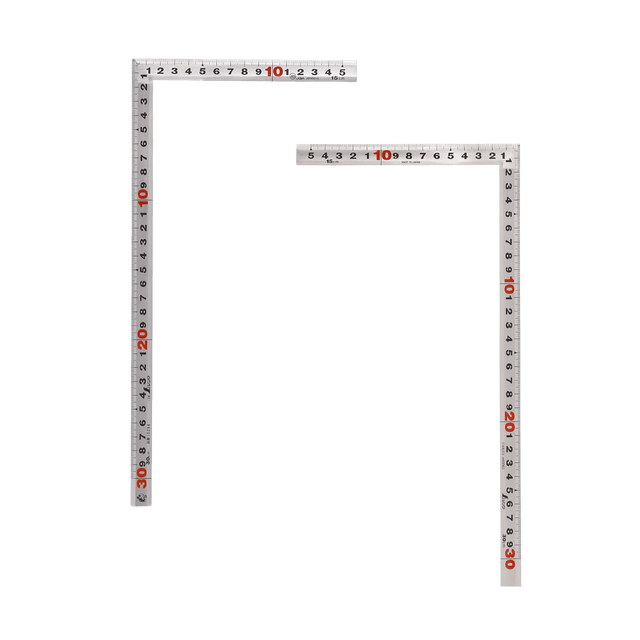
30 × 15 cm Traditional Sashigane
The same ink-friendly traditional profile in a bench-sized square, with centimetre markings.
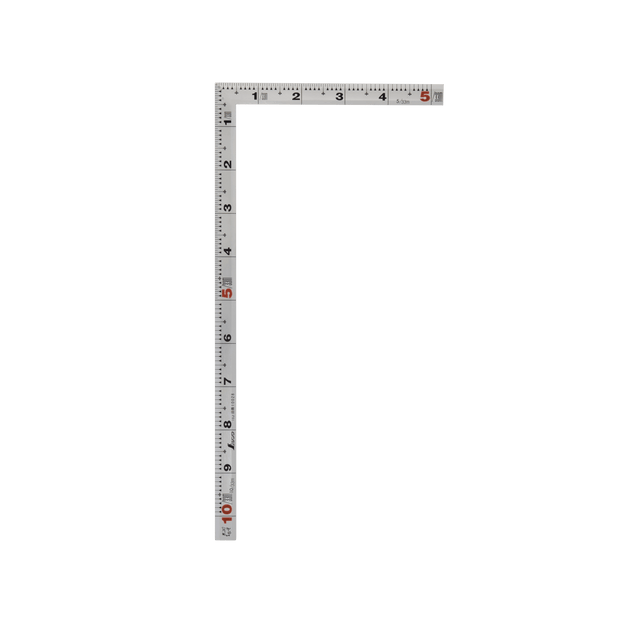
30 cm Sashigane, Shaku and Metric
Sun and bu on the front, millimetres on the back. For working in Japanese units.
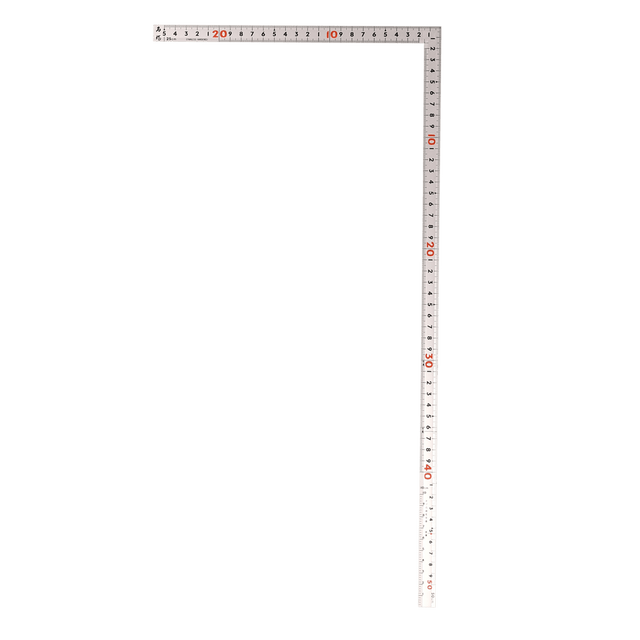
50 cm Sashigane, All-Metric
The traditional sashigane shape with plain metric scales, if you don't need the calculated ones.

30 cm Hiropita Carpenter's Square
Thin stainless steel made to JIS standards in Japan. Flexes to follow curved and uneven work.
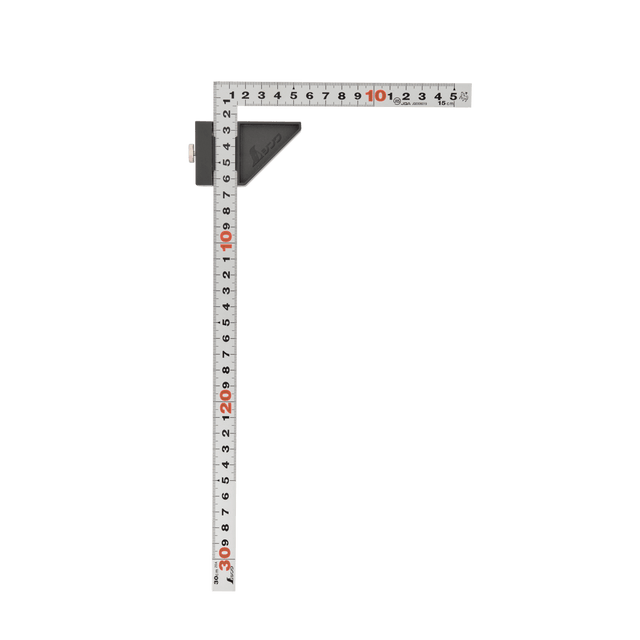
30 cm Carpenter's Square with Stop
A sashigane with a sliding stop, so you can mark consistent parallel lines from an edge.
Western squares
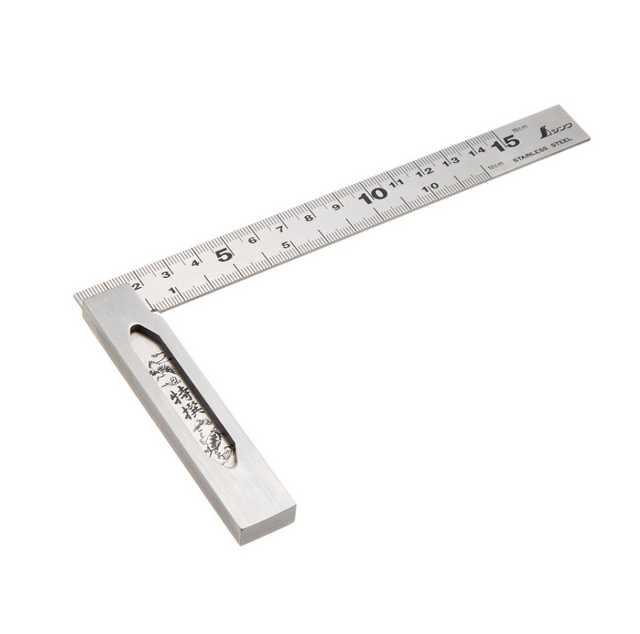
15 cm Try Square
All stainless steel. Millimetres on both edges of both sides, with a relief in the inside corner.
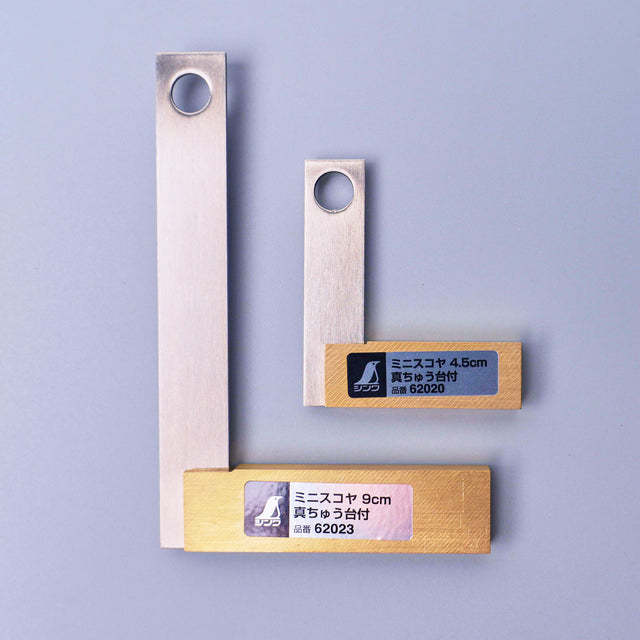
Mini Try Squares
45 mm and 90 mm sizes for marking out fine joinery and small parts.
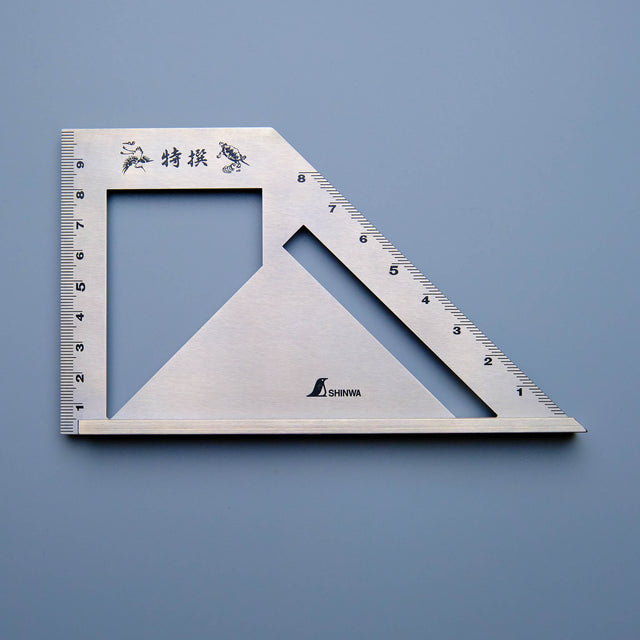
Mitre Ruler 45°/90°
A 45° and 90° reference surface in one tool for cutting and marking.
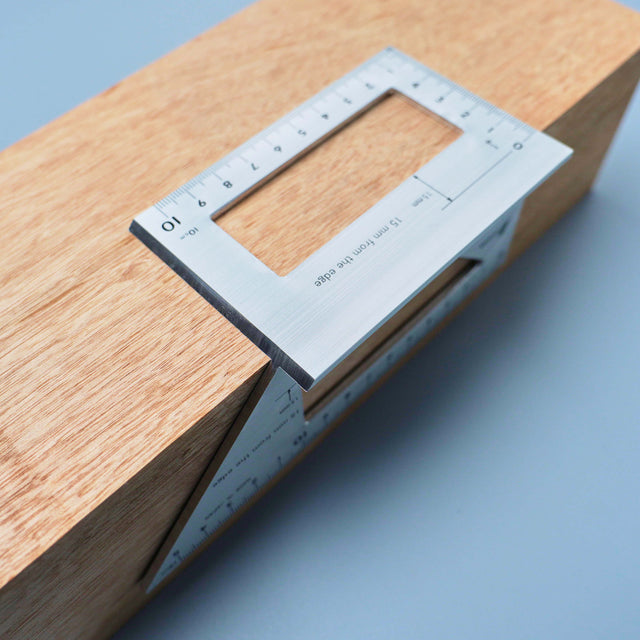
45°/90° Aluminium Layout Gauge
A light, accurate 45° and 90° layout tool for the bench.
Questions
I only want one square. Which should it be?
For furniture and small joinery, the 15 cm Try Square. For anything wider than about 15 cm, such as cabinet sides, framing, decking or beams, a sashigane. The 50 × 25 cm Traditional is the one Japanese carpenters reach for first.
Why does my sashigane flex? Is it faulty?
No, that's by design. The thin steel lets it lie flat on a cupped or uneven board and wrap around a post to carry a line around it. The corner is kept thick so the right angle stays put.
Do I need the kakume and marume scales?
If you work with round timber, roof framing or anything that starts as a log, they save real time. For furniture and cabinet work, a plain metric sashigane like the 50 cm All-Metric does the job.
Should I work in shaku or metric?
Pick one system and stay in it for the whole project. Converting between sun and millimetres mid-job is where mistakes creep in. One sun is 30.3 mm, one bu is 3.03 mm, and ten sun make one shaku (303 mm).
What is a stop for?
A stop clips onto the arm and acts like a small fence, so you can mark a run of lines at the same distance from an edge. Shinwa makes squares with stops fitted, and separate 15 mm and 20 mm metal stops.
Start with the carpenter's square
Shinwa 50 × 25 cm Traditional Sashigane · $85 · free shipping · made in Japan