

Every country has its own woodworking traditions, and Japan's come with a genuinely distinct personality — tools shaped by centuries of refinement, built around the pull stroke rather than the push, and engineered to reward patience with a finish that's hard to match any other way. If you're new to Japanese tools, here's what makes them different, and where to start.
Why pull instead of push?
Most Japanese saws and planes cut on the pull stroke rather than the push. That single design choice changes everything about how the tool behaves: a blade under tension (being pulled) can be made much thinner than one under compression (being pushed) without buckling. Thinner blades mean narrower kerfs, less material removed, and — with a light touch — genuinely more accurate cuts. The trick with pull-stroke tools is resisting the urge to force them; let the blade do the work and guide it, rather than pushing through the cut.
The two techniques behind the sharpness
A lot of Japanese chisels and plane blades share two features that explain why they sharpen so well and stay sharp so long:
- Haganetsuke — laminating a hard steel cutting edge onto a softer iron backing. You get the sharpness and edge-holding of hard steel, with the softer backing adding flexibility and making the whole blade easier to sharpen than an all-steel equivalent.
- Ura-suki — a slight concave hollow ground into the back of the blade. It reduces the surface area that needs to touch the sharpening stone, which makes flattening the back faster and more accurate — a small detail that makes a real difference at the stone.
The core toolkit
Hand saws (Nokogiri)

Saws vary by length, blade thickness and tooth pattern, each suited to different materials and cuts. The most iconic is the ryoba — a double-edged saw with rip teeth on one side and crosscut teeth on the other, versatile enough to be the only saw many woodworkers own for years. If you want to start with just one, this is it, and 240mm is the standard size to reach for.
Chisels (Nomi)

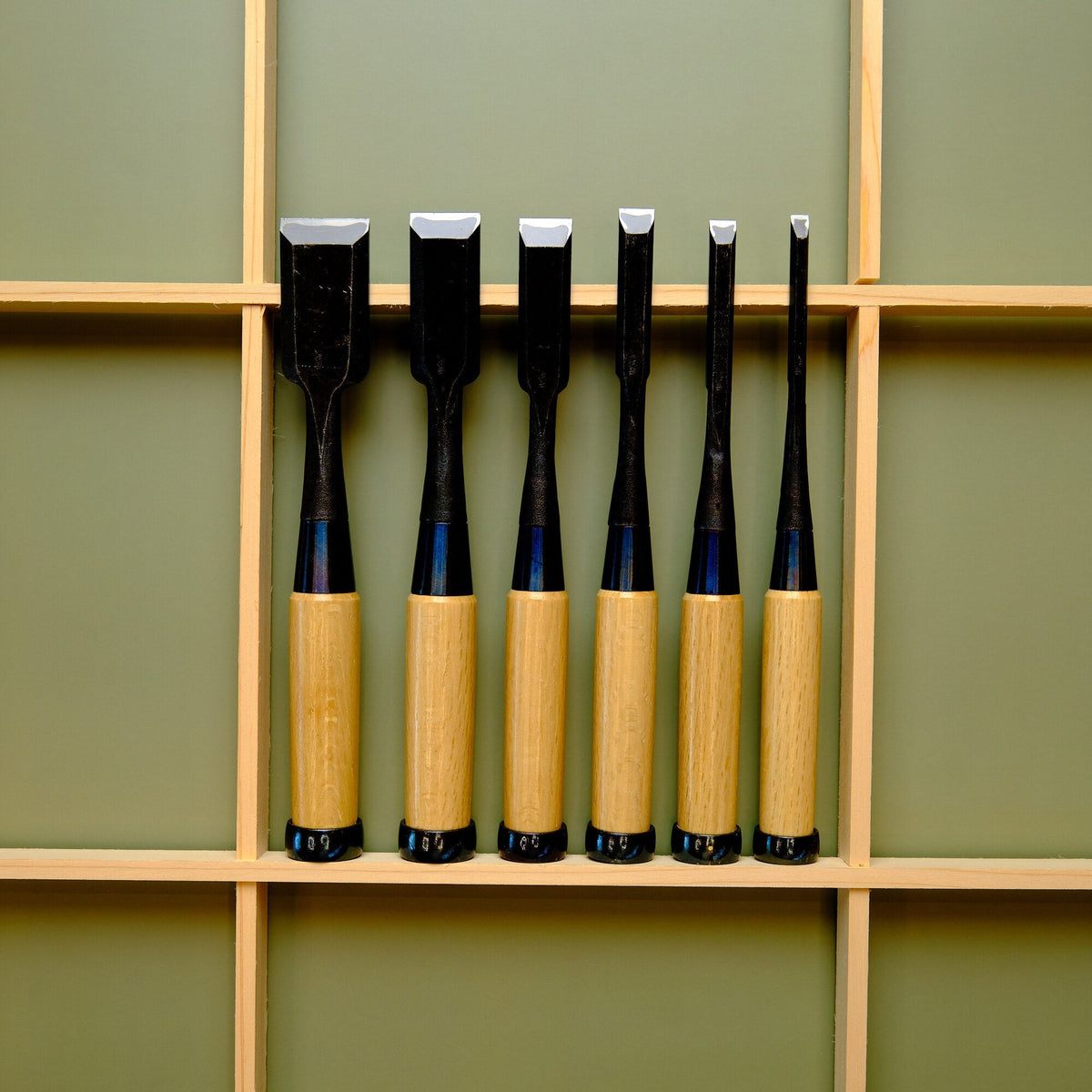
Used for carving, cutting joints, and cleaning up holes, with blade shape varying by task. Most feature that same haganetsuke construction and ura-suki hollow, with wooden (often oak) handles. There are two broad families: tataki-nomi, struck with a hammer and reinforced with a metal hoop (katsura) to stop the handle splitting, and tsuki-nomi, designed to be pushed by hand. The most versatile all-rounder is the oire nomi — a great first chisel.
Hand planes (Kanna)

Used to smooth and flatten wood, most commonly as a flat plane (hira-kanna). Modern kanna typically pair a main blade with a chip breaker to prevent tear-out — a detail borrowed from Western plane design. Because the wooden body shifts with humidity, a kanna needs regular tuning, adjusted by gently tapping the blade or body with a hammer. It's more upkeep than a metal-bodied Western plane, but a well-tuned kanna produces a mirror finish that's genuinely hard to replicate any other way — and the planed surface even becomes water-repellent.
Hammers (Genno)

Used for driving nails and striking chisels, and in Japan, for adjusting plane blades too. Head shapes and weights vary by task — some faces are gently rounded to avoid marking wood, others flat for general versatility, and some thin and blade-like specifically for tapping plane blades without damage.
Marking tools

Accurate marking underpins everything else. The kebiki (marking gauge) draws a consistent line at a set width, over and over, by scoring rather than just marking the surface — which gives your saw or chisel a physical line to follow rather than just a visual one.
Choosing your first tools
Saws: think about blade thickness (durability vs. fine accuracy), blade length (maneuverability vs. material removed per stroke), and tooth size (speed vs. finish). If you're newer to woodworking, a medium-sized ryoba is the easiest place to start.
Chisels: match the width to the work — too large and you simply can't make the cut you need. The oire nomi is the most broadly useful type to own first.
Planes: choose a blade slightly wider than your material. Go narrower and you'll need multiple passes to cover the surface evenly, which is a lot harder to get right without experience.
Hammers: match the head material to the job — softer metals like copper or brass (or a wooden mallet) protect delicate surfaces like plane blades or assembled joints, while a standard steel face suits general use.
Where to go from here
None of this is meant to be mastered in a weekend — Japanese tools reward the process as much as the result. Start with one good saw, one good chisel, and a plane you're willing to spend some time tuning, and the rest of the craft opens up from there.


